
Understanding Site Engineering: A Key Component in Construction
What is Site Engineering?
Site engineering is the process of transferring design information from drawings into physical positions on the ground. A setting out engineer uses precise surveying instruments to mark the exact positions of foundations, columns, walls, drainage runs, and other structural elements. This ensures that construction proceeds in the correct location and at the correct level.
Without accurate setting out, even a small error in the position of a foundation or a slight deviation in level can create significant problems later in the build. This is particularly true when structural elements, utilities, and finishes all depend on the original layout being correct.
What Types of Projects Need Setting Out?
Site engineering is relevant to a wide range of construction projects, including:
New residential builds, where foundations, walls, and drainage all need to be set out accurately from the engineer's drawings.
Commercial and industrial construction.
Road and infrastructure works.
Retaining walls, drainage schemes, and earthworks.
Extensions and outbuildings, where the new structure must be correctly positioned relative to the existing building and boundaries.
Solar farm and renewable energy installations.
The Importance of Survey Control in Setting Out
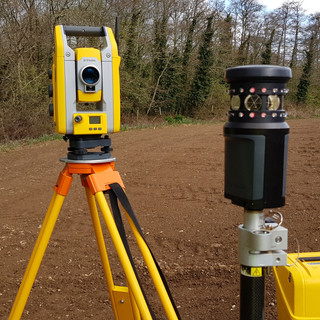
Before setting out can begin, we establish a network of survey control points on site using GPS and total station equipment. These control points provide the reference framework from which all setting out measurements are made. Using a Trimble robotic total station, we can then set out positions with millimetre precision. This allows us to work efficiently across the site without needing a chainman for most tasks.
We work directly from the engineer's coordinate data, site plans, or AutoCAD drawings. If design coordinates are not provided, we can calculate setting out data from the drawings and cross-check against the design intent before putting marks on the ground.
As-Built Surveys: Ensuring Compliance and Accuracy
Once construction is complete or at key stages during the build, an as-built survey verifies that the works have been carried out in the correct positions and at the correct levels. As-built surveys are used to confirm compliance with the design, identify any deviations that need to be resolved, and provide a record of what was actually constructed.
These surveys are particularly important for drainage and utilities, where the position and level of buried services need to be recorded before backfilling. They are also critical for structures where tolerance is essential, such as steel frames, modular buildings, or precast concrete elements.
Collaborating with TruGrid Surveys Ltd for Site Engineering
TruGrid Surveys Ltd provides site engineering and setting out services across Cornwall and Devon. We are a Truro-based practice led by Aaron Bennett, who has over 24 years of experience in residential, commercial, and infrastructure projects.
We utilise Trimble robotic total station and GPS equipment, allowing us to work efficiently as a solo operator. We also provide clear setting out records and as-built survey reports upon completion.
To discuss a site engineering requirement or request a quotation, contact us at info@trugrid.co.uk or call 07977 816012. Most quotations are returned within one working day.
The Benefits of Accurate Setting Out
Accurate setting out is not just about avoiding mistakes. It is about ensuring that the entire construction process runs smoothly. When the initial stages are executed correctly, it saves time and money in the long run. Here are some key benefits:
Enhanced Project Efficiency
When everything is set out accurately from the start, the construction team can work more efficiently. They can follow the plans without second-guessing measurements or making adjustments. This leads to faster project completion and reduced labour costs.
Improved Quality Control
With precise setting out, the risk of errors decreases significantly. This means that the quality of the construction is enhanced. Structures are built as intended, and compliance with design specifications is maintained.
Reduced Risk of Delays
Delays in construction can be costly. By ensuring that setting out is done correctly, the likelihood of delays due to rework or corrections is minimised. This keeps the project on schedule and within budget.
Increased Safety
Accurate setting out contributes to a safer construction site. When structures are built according to the correct specifications, the risk of structural failures or accidents decreases. This is especially important in complex projects where safety is paramount.
Conclusion: The Importance of Partnering with Experts
In conclusion, accurate setting out is a fundamental aspect of successful construction projects. It requires expertise, precision, and the right tools. By partnering with professionals like TruGrid Surveys Ltd, you can ensure that your project is set up for success from the very beginning.
For any site engineering needs, do not hesitate to reach out. We are here to provide the precise and timely data you require for your construction, architectural, and engineering projects.

Comments